Every status report says “on track.” Every leader knows better.
RaiDAR is the first platform to run delivery as
living objects, not documents — an agentic AI keeps them true in
real time and surfaces the few decisions that decide the outcome.
Objects, not documentsAgentic by designDecisions, not dashboardsBare-naked transparency
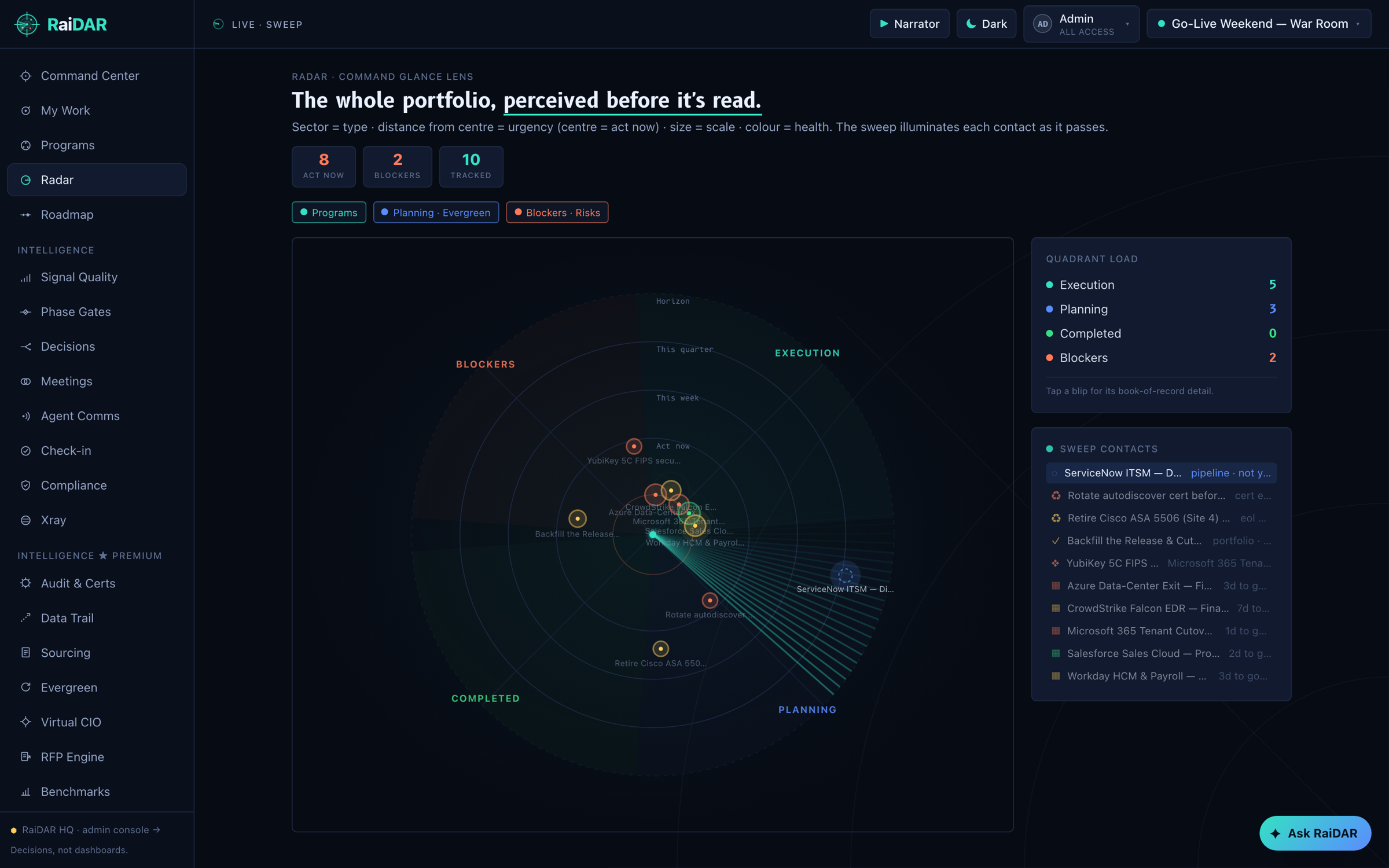
Every program a blip — distance is urgency, colour is truth.
The actual platform · live build
raidar.one · radar · live sweep
Not a mockup. This is the working build — the Radar's Command Glance Lens during a
go-live war room: 8 act-now contacts, 2 blockers, the sweep illuminating each program as it
passes. Sector = type · distance = urgency · colour = health.
The lie at the center of it all
Leaders make million-dollar calls on a date someone made up.
Everyone reporting status is in self-preservation mode — intentionally or not — so they'd
rather drag the bar than explain the slip. RaiDAR computes
the date from what's actually happening. Impossible to fake.
“On track — Mar 31”
→
Computed: May 1278% confidence · updated live
The PMO today
A framework, a filing cabinet, and brute force.
Aligned to PMI. Certified to the hilt. And underneath: static documents in SharePoint,
decisions scattered across inboxes and Teams threads, mountains of meeting minutes
nobody reads twice.
SharePoint libraries
Inbox threads
Teams chats
Meeting minutes
Status decks
Final_v7_FINAL.pptx
How do you keep a system like that alive — useful, accurate? You can't. You brute-force
it with human capital — chasers, re-typers, Sunday-night heroics — and it still drifts
from reality the moment it's written down.
Not sustainable. Definitely not accurate.
This is the universal lie. PMP, PMI, PMBOK — indoctrinated into the roots of almost every
PMO — are compensation for information the system can't surface itself. Ceremony as a
substitute for signal. Hence the perpetual search for a better way. The best of the
current tools got close to “real time” — they're still sheets you have to feed.
“My IT career started deploying Project Server — multimillion-dollar rollouts,
astronomical effort to maintain, and they still ended up as glorified spreadsheets.”
— Harnish, founder
The re-baseline loop
Plans don't slip. They reset.
What would it actually take to predict when a project lands? Live inputs.
What does it take to write a plan? A deadline and a template. Guess which
one delivery runs on.
What a real date needs
✓Live capacity — who's actually free, not who's allocated
✓Lead times from history — what this vendor actually takes
✓Dependency state — what's blocked, right now
✓Measured velocity — on this work, not the last project's
So reality drifts, and the plan gets “corrected.” Re-baselining sounds like
control — it's the reset button. New baseline, same fiction, later date. Round and
round, until go-live is wherever the road runs out.
The slip chart every IT program knows. Each re-baseline resets the promise; none of them
changes the landing. The computed date converges on the truth, ships — and never once
needed a reset, because it was never fiction to begin with.
$2T
wasted on poor project delivery worldwide, every single year
$1M / 20s
one million dollars lost every twenty seconds, collectively
30 yrs
of platforms that were filing cabinets underneath — until AI could reason over messy reality
Source: Project Management Institute (PMI), Pulse of the Profession — organizations collectively waste ~$1M every 20 seconds through poor project implementation.
What’s coming
✕Not another tool.
✕Not another tool with AI sprinkled on top.
✕Not another bot that takes the minutes.
Project delivery finally has a platform.
Your portfolio as a live radar. Every program a living object with a heartbeat.
Every signal traced to a decision. No ceremonies, no chasing, no theatre.
Every system in. One truth out.
That's the name. raidar.one — every system streams in, and what comes out is
singular: one radar, one honest date, one decision at a time.
01
Live Command Center
Your whole portfolio on one radar — RAG status computed from reality, not reported by hand. Perceive health before you read a word.
02
The honest date
A floating, computed go-live date with a confidence score — recalculated continuously from signals, checkins, and dependencies.
03
Signal → Decision
A book of record. Every risk, slip, and escalation lands as a decision with an owner — append-only, auditable, undeniable.
04
60-second check-ins
A bot asks the one question that matters, right in the flow of work. No standups, no status meetings — the data collects itself.
05
Agentic outreach
The platform chases vendors, suppliers, and stakeholders itself — and brings you only the fork-in-the-road decisions.
06
ERP-fed finance & proof
Budgets, burn, grants, and proof-of-delivery wired to source systems — the numbers in the room are the numbers in the ledger.
Agentic, in plain English
It takes the chasing. You keep the choosing.
A chatbot waits to be asked. An agent gets on with the job. That's all
“agentic” means: the platform acts on its own — it doesn't think
for you, it does the legwork around you.
Taken off your plate
✓Chasing vendors and suppliers for updates
✓Typing the same status into three systems
✓Writing minutes nobody reads twice
✓Reconciling which version is true
✓Scheduling meetings to discover blockers
✓Remembering who owes what, by when
Left in your hands
The decision.
The trade-off. The judgment call. The accountability. The one thing that was always meant to be human.
What the chasing costs
60%
of the workday goes to “work about work” — chasing status, app-switching, communicating about work instead of doing it
$37B
lost by US businesses every year to unnecessary meetings alone — ~31 hours per person, per month
1 day / week
per knowledge worker spent hunting for information — or for the colleague who has it
Sources: Asana, Anatomy of Work Global Index (“work about work” incl. chasing the status of work);
Atlassian meeting research (unnecessary-meeting salary cost, US); McKinsey Global Institute,
The Social Economy (~20% of the workweek searching for internal information or people).
Not AI replacing people — AI returning people to the work only they can do.
The quiet mind
Go home done. Come back certain.
The anxiety of modern delivery isn't the workload — it's the fog. Four inboxes,
forty threads, a dozen static tools each holding a different version of the truth,
and the 9pm feeling that something, somewhere, is quietly slipping.
RaiDAR ends the fog with one rule: if it matters, it's on your radar.
Nothing decisive lives in your inbox, in a Teams thread, or in the minutes of a
meeting you missed. Keep your radar clear and you are — genuinely — done for the day.
And the ceremonies that existed to manage the fog — daily stand-ups, scrums,
all-hands, steering committees that cost real money and produce almost nothing —
have no reason left to exist.
Tuesday · 18:04
Radar clear.
✓Nothing waiting on you
✓2 decisions logged · owners assigned
→Tomorrow's first: vendor date change — 5-min review
Everything else is watched while you're away. See you tomorrow.
Audit by design
The auditors ask. The record answers.
Every signal, decision, and date change lands in an append-only, hash-chained book of
record — attributable, timestamped, tamper-evident. Come audit season, nobody
reconstructs history from inboxes and meeting minutes. The history was never anywhere else.
SOX · ITGC
Who changed what, when, on whose authority — every entry attributable and immutable.
SOC 2 Type II
Period-of-time evidence produced continuously — not screenshots scrambled the week before fieldwork.
ISO 27001
Risks, decisions, and treatments with named owners and dates — by default, not by discipline.
21 CFR Part 11 · ALCOA+
Records that are attributable, contemporaneous, and original — captured at the moment of the event.
2 CFR 200 · Single Audit
Grant spend tied to proof-of-delivery, end to end — every public dollar traceable to an outcome.
FOIA · Procurement
A defensible trail for every decision — without the records-request panic.
A tamper-evident record doesn't make an organization certified — your controls and your
auditors do. It makes the evidence they ask for a byproduct of working, not a project of its own.
For your next board meeting
The answer to “What is our AI strategy?”
Every board is asking it. Most answers are a pilot and a chatbot. Yours is delivery
itself running on agentic AI — live, in production, on your biggest programs.
For 30 years, this was impossible
Now it isn’t.
We’re onboarding a small set of design partners ahead of launch.
If your portfolio is bigger than your visibility, we should talk.